

Chasing shadows
There are some places I seem to be able to return to multiple times and never get tired of photographing them. Partly it might be because I feel I haven’t captured exactly the image I have in my head, partly it might be because the familiarity of the location makes me feel happy, and partly it might be something else.
I think when it comes to the set of stairs beneath the Roger Stevens Building at the University of Leeds, it might be the third thing.
That’s not to say I’m not always trying to get a better photograph, or that it doesn’t make me happy to be there, doing my thing. I am, and it does. But there’s something else that keeps pulling me back to that specific spot. Many of you will be familiar with my love of the brutalist architecture at the University, and in particular of my affection for the Roger Stevens Building in particular, but it’s this rather unassuming staircase that really draws me in.
A quick overview of this location before I get into the specifics. The Roger Stevens Building was designed by the architects Chamberlin Powell and Bon, who are also the ones behind the Barbican Centre in London, so they know what they’re doing with concrete. It’s grade II* listed and has some absolutely breathtaking features but I’m not going to talk about them here. That can be the subject of another blog, perhaps with some nice interior shots.
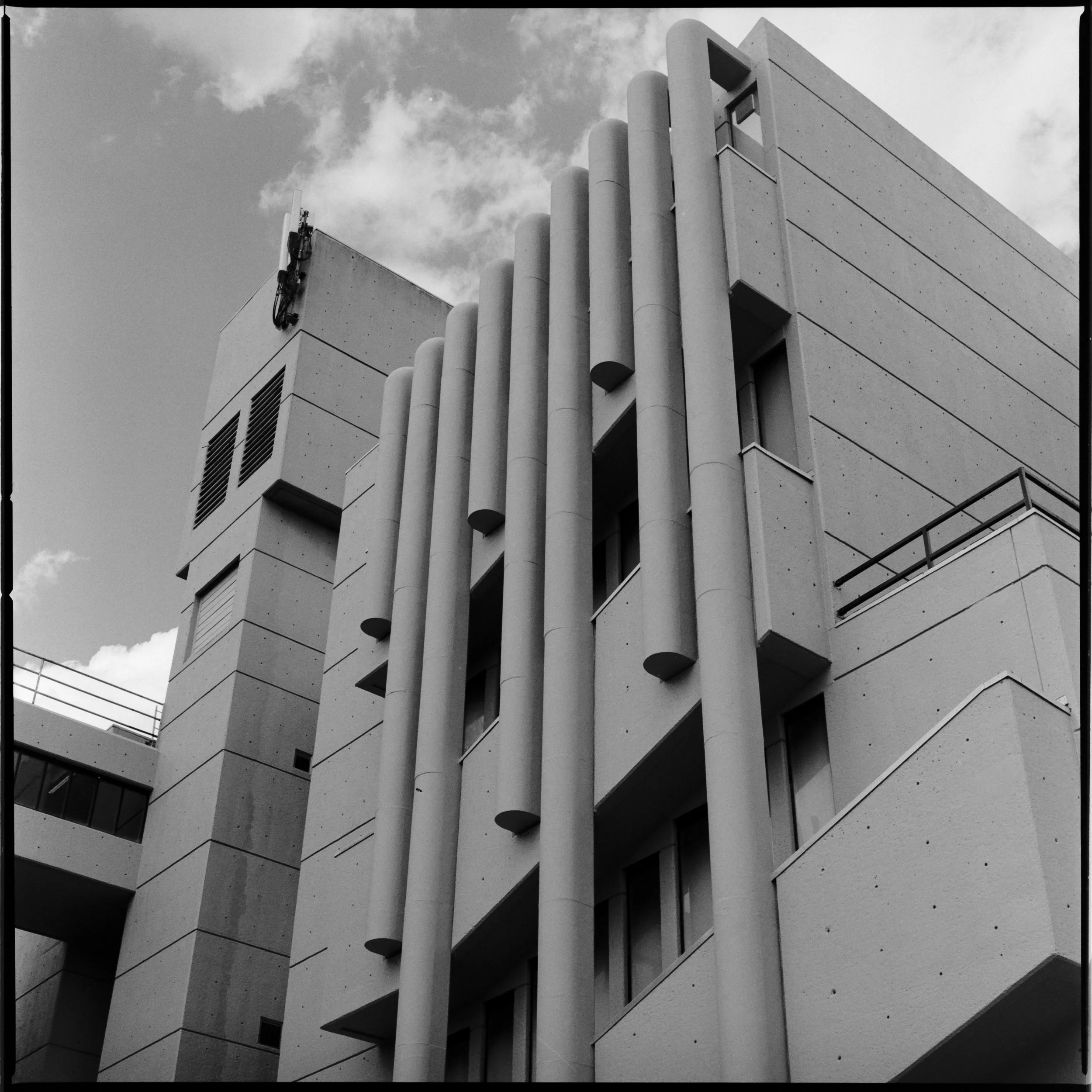
Roger Stevens Building, exterior.
This shot shows the distinctive “organ pipes” which are actually ventilation shafts.
Hasselblad 500 C/M + 80mm Planar f/2.8
So when presented with an exterior as visually stunning and powerful as this, why would you be drawn to a shadowy concrete staircase beneath that building? There’s so much else to photograph, why concentrate on that and why come back to it again and again?
It’s to do with the shadows and the light. And when I say that I mean literally and figuratively. Let me show you a picture and then explain what I mean.
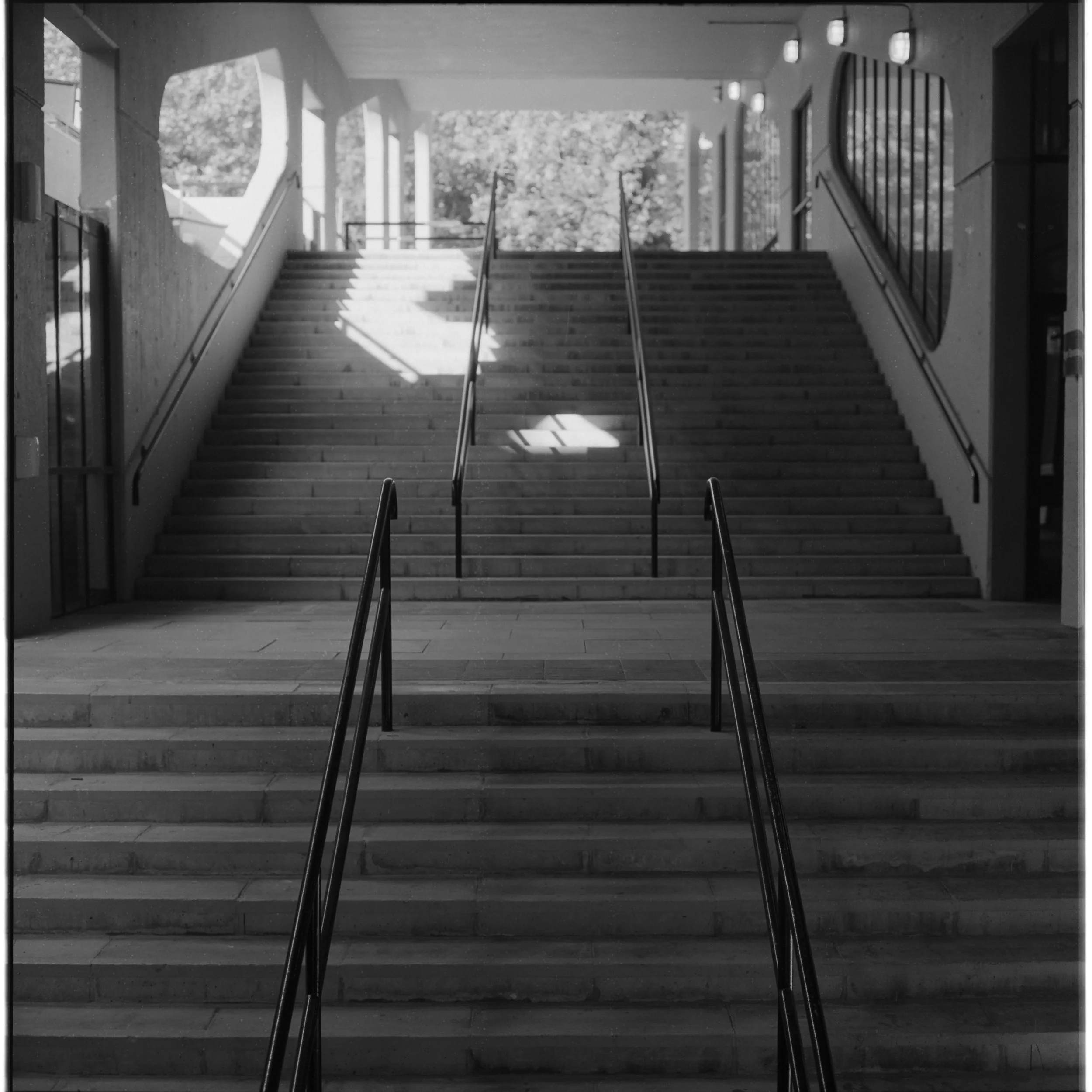
Staircase 1, Rolleiflex 2.8f
The staircase is quite dark, but on a sunny day there are very bright highlights, so getting the exposure right can be a challenge. I don’t want to blow out the highlights, but I also don’t want to lose the detail in the dark spaces. And I want those spaces to be very dark. In Staircase 1 you can see that I used a fairly wide aperture for this image, effectively separating the sharp nearer steps from the ones further back which are softer, and introducing some nice bokeh in the background at the top. This was partly intentional, and partly because I was shooting handheld so couldn’t go below 1/60 and needed to shoot fairly wide to achieve that (f/4 I think).
I particularly like the fact that it is possible to photograph this staircase from an elevated position level with the mid part of it, so I’m not shooting it from the bottom with all the perspective disappearing up and away. Instead I am looking at the staircase from a position someone using it wouldn’t see.
I like this image, but I knew I wanted one which was sharper across the frame, so I came back with my tripod.
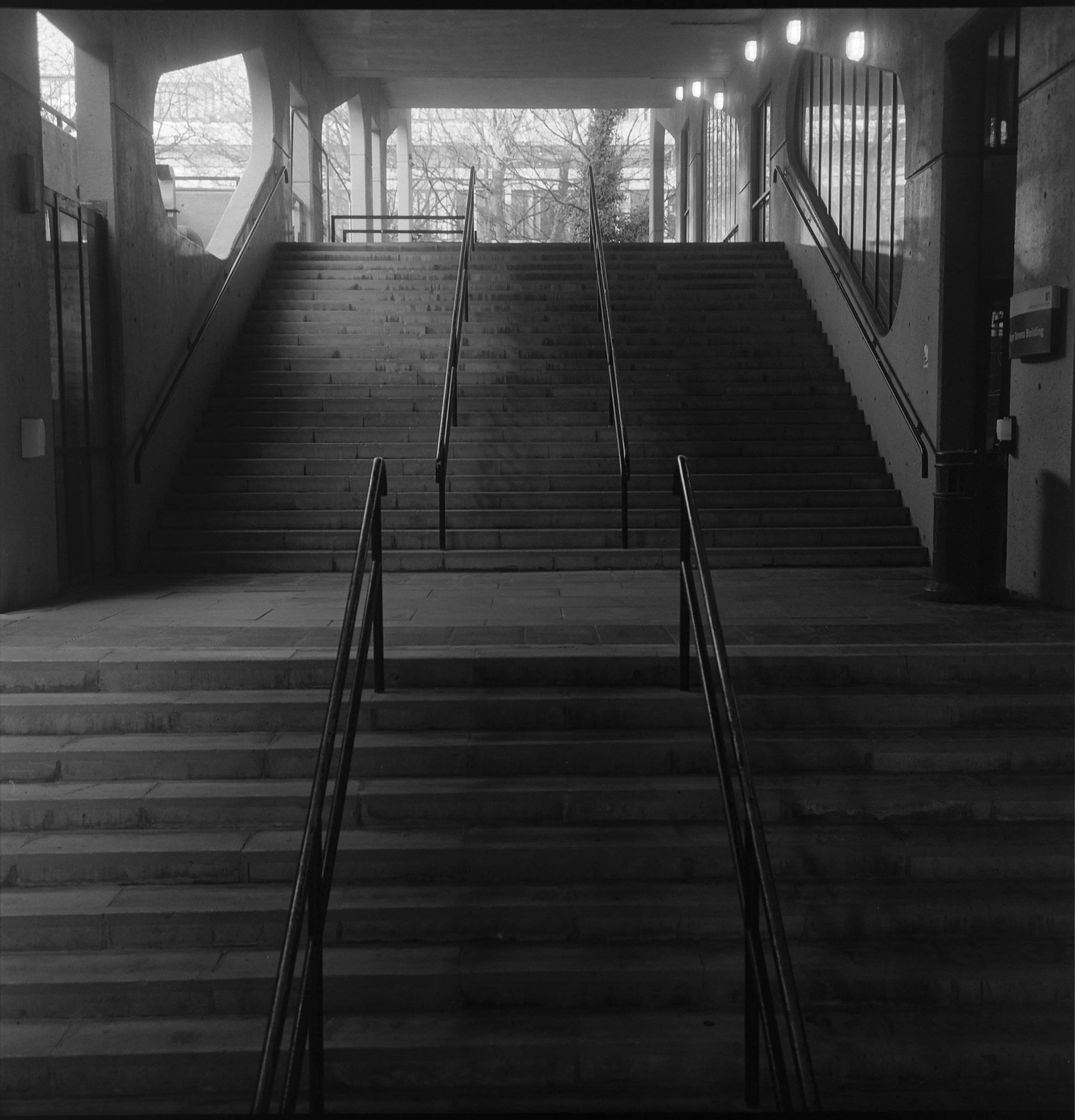
Staircase 2, Rolleiflex 2.8f
Whilst on the face of it these images look quite similar (they are shot with the same camera and on the same film stock) there are quite a lot of differences. As well as having a much wider depth of field (shot on a tripod at f/16), the light in this one is very different. It was a cloudier day so the shadows are not as harsh. I really like that as it gives such depth to the range of tones across the frame. It also somehow reflects more off the concrete, making it seem smoother and shinier. I’m not alone in liking this one as it has proved quite popular and is one of my best selling prints. People do like the shadows and the whole sense of possibility that comes with a staircase.
I won’t share all the images I have of this staircase (many 35mm ones shot handheld with dodgy framing and poor horizon control!) but trust me when I tell you there are dozens of them. I am always drawn back to the shadows. Of course you can’t have shadows without light, and it’s the right combination of the two which makes this image special.
Yesterday I unexpectedly had a little time on my hands, so I went down to the university with my large format camera with the intention of capturing a good image of this staircase which was even sharper than the shot from the Rollei on the tripod. It was a nice day and campus was busier than I expected, but the back of this staircase is usually quiet. I took my time setting up, and decided to use my 135mm f/5.6 lens as it’s roughly equivalent to a 40mm lens on a 35mm camera, so not too wide.
Metering for this sort of shot is a challenge, and I used a combination of incident and spot readings to get the right exposure. I then ended up bracketing a stop either way so I could compare the negatives and see which I preferred. The exposure I went in the end was ½ second at f/32.
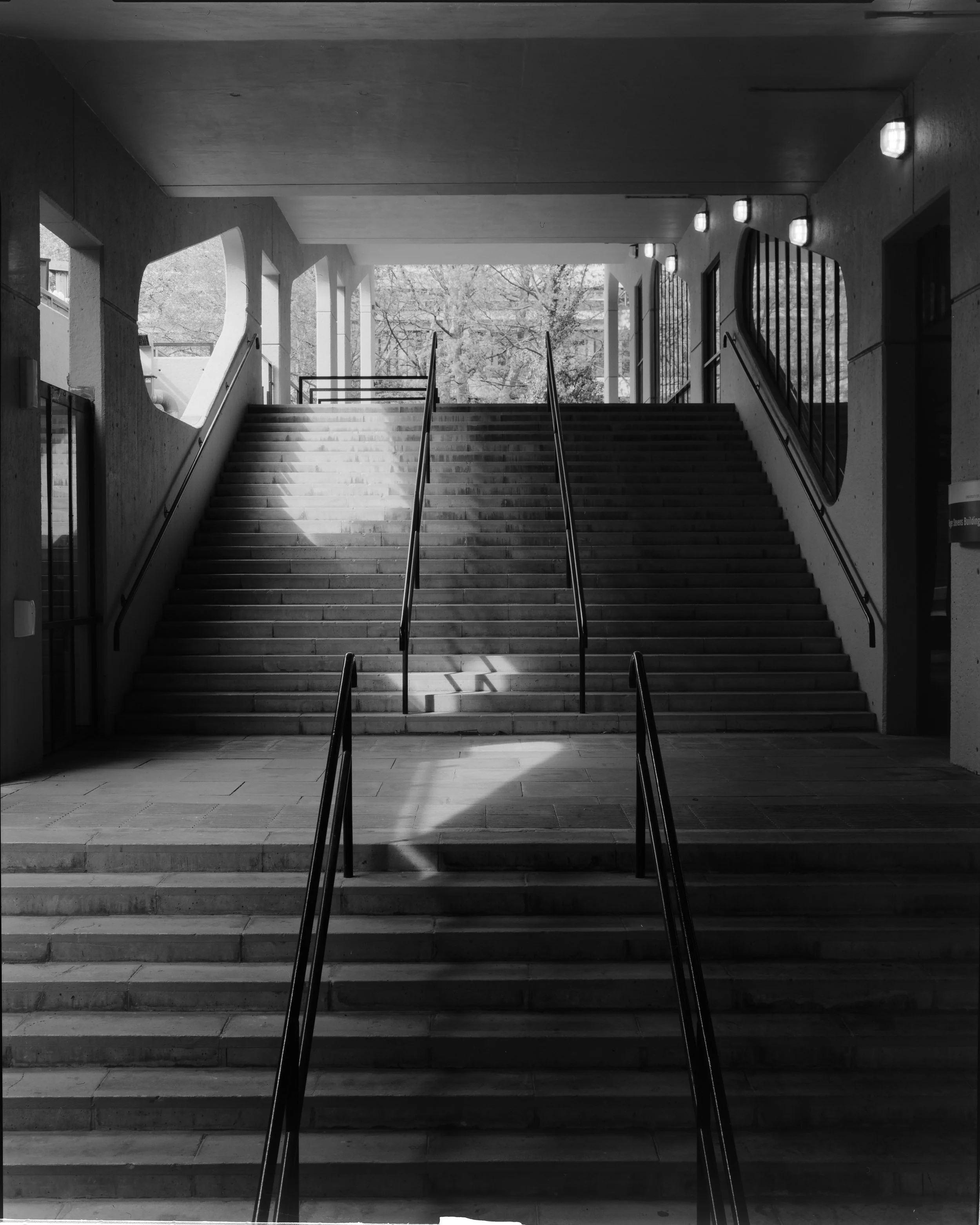
Stairs 3, Intrepid 4×5 + Fujinon 135mm f/5.6
I developed the sheets of film yesterday evening and managed to grab some time to scan them today.
I am very happy with this frame. It’s only a DSLR scan of the negative, but it looks very promising to me. I like that even though the bottom right hand corner is very dark you can still make out the lines of the steps, and at the same time you can see the trees very clearly at the top, and even the building behind. I love the reflections in the windows on the right hand side, and the texture of the concrete all over. I can’t wait to get into the darkroom and make some prints of this. I have some very large paper (16” x 20”) and I am very keen to see what this looks like at that scale.
Staircases have been a popular subject in photography since the very beginning. I love this one because of what it shows and what it doesn’t show. I could get lost in the shadows here. I don’t know where they would take me.